

In January 2024, Oxy signed the Second Nature Climate Pledge, putting us on track to develop a comprehensive, data-driven Climate Action and Sustainability Plan.
Understanding the imminent impacts of global climate change, Oxy has committed to not only adapting to a changing climate, but also to making efforts to reduce our impact on the environment. After decades of action on climate, in January 2024, Oxy formalized its commitment to environmental sustainability by signing the Climate Commitment, providing a structured path forward to reduce our carbon footprint and make ourselves more resilient to climate impacts. The college pledged to develop a Climate Action & Sustainability Plan (CASP), with time bound goals for reaching carbon neutrality and other identified priority actions.

President’s Sustainability Advisory Council (PSAC)
Part of the pledge required the college to develop a governance structure for writing and implementing our Climate Action & Sustainability Plan (CASP). Thankfully, such a structure already existed. Originally established in 2022 as the “Occidental Climate Resilience and Equity Task Force,” the President’s Sustainability Advisory Council is composed of students, staff, faculty, and board members that meet once per semester to discuss progress, advise on next steps, and act as liaisons with their respective stakeholder groups.
The Office of Sustainability
The responsibility of ensuring the College meets the targets agreed to in the Climate Commitment falls to the “implementation liaison,” so-called by Second Nature. In our case, this is the Office of Sustainability. After a four-year dormancy, the office reopened with the hiring of an Assistant Director of Sustainability and Assistant Sustainability Coordinator. Learn more about the office on our People & Organizations page.
FY23 Baseline Greenhouse Gas Inventory
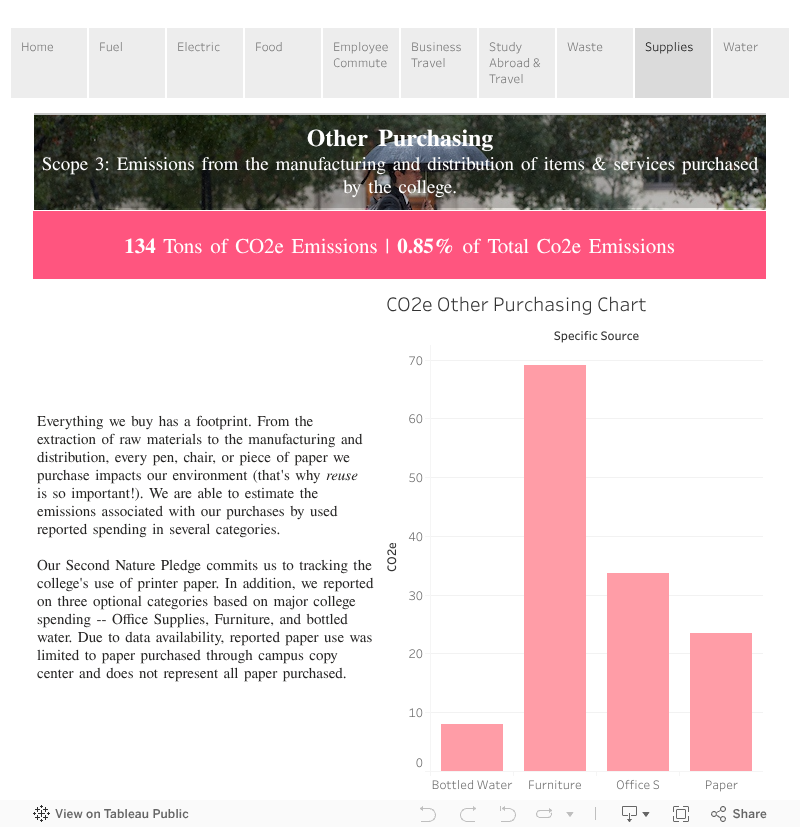
Over the course of 15 months, the Office of Sustainability collected data for a baseline greenhouse gas inventory of the College’s Scope 1, 2, and 3 emissions. This involved gathering and organizing data from dozens of sources on campus and uploading synthesized findings into the University of New Hampshire’s Sustainability Indicator Management and Analysis Platform (SIMAP), which estimates the carbon and nitrogen emissions from the college’s spending and utility use. Fiscal Year 2023 (July 1, 2022 - June 30, 2023) was chosen as the baseline year. CASP targets and goals will be based on the emissions from FY23.
Including Climate Resilience in the Plan
As the Climate Action and Sustainability Plan is developed, considerations will be given to actions that can make the campus more resilient in the face of climate change. For instance, nature-based solutions such as increasing native plants and reducing lawn cover can reduce water usage, provide natural cooling and also offer calming spaces for passive recreation and study as a way to mitigate against predicted increases in extreme heat days. In collaboration with The Nature Conservancy and Second Nature, Oxy convened campus stakeholders to learn more about perceived climate risks, and opportunities to improve campus climate resilience. A summary of these workshop findings and identified priorities is available below. Preparations to address emergencies caused by our changing climate are also being addressed by the Emergency Response Team. Please visit their page to learn more and find Emergency Specific Guidelines.
Read Summary of Findings (March 2025)